
PVC window-profile knife RFQ guide: what buyers should send before ordering shredder, crusher, or granulator knives
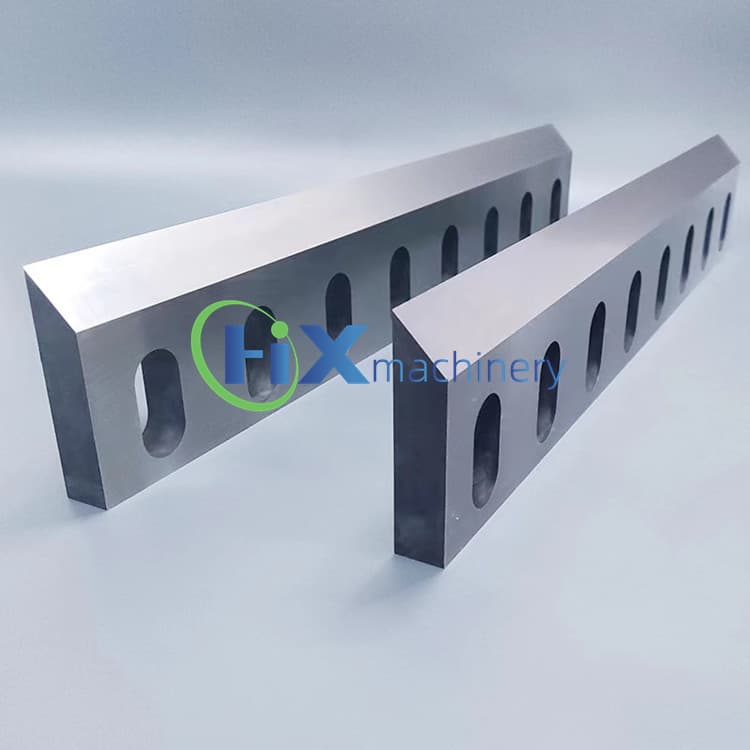
If a PVC window-profile recycling line suddenly runs hotter, makes dustier regrind, or sends unstable feed into the next machine, the first RFQ question is not which steel is hardest. The first RFQ question is whether the quotation is describing the right machine stage and whether the buyer has named the actual profile condition, reinforcement condition, and downstream complaint.
REHAU says recycling plays a significant role in turning window waste into new window profiles and technical products. VEKA says recycling old PVC windows and production waste keeps valuable material out of incineration and notes that old windows are a real feedstock with a long service life behind them. That confirms the commercial stream. It does not mean every knife duty is the same.
The machine-stage fit matters because ZERMA says PVC-industry hammer-mill solutions are still used to separate used window profiles from metallic reinforcement and fittings. REHAU's PVCR capacity note describes pre-shredding as a key first step in a recycling-capacity increase. The buyer conclusion belongs early: if the profile stream, reinforcement content, or stage responsibility changed, a same-geometry reorder can be mechanically correct and commercially wrong.
So the RFQ should start with the real line context. Say whether the job is opening whole frames, pre-shredding reinforced profiles, crushing sorted rigid profile scrap, or stabilizing granulation after metal separation. Send installed photos of moving and fixed knives, note whether reinforcement, seals, or fittings are still present, and state the next-stage complaint if one exists. That is the shortest path to a quotation that solves the plant problem instead of repeating it.
What the official recycling flow says about the knife job
Official PVC window recycling sources do not describe a clean, uniform feed appearing magically at a granulator. They describe staged separation and preparation. In VEKA's 2022 corporate responsibility report, used PVC windows arrive complete with reinforcements, seals, and glass remnants, then go through delivery and shredding, metal separation, and PVC extraction. That single process description explains why a spare-parts RFQ for this cluster cannot be written as though every line is only buying a loose crusher blade.
REHAU's sustainability page adds the closed-loop context by linking recycled window waste back to new profile production and recycled-material use. VEKA's recycling page adds that old windows and production waste are a practical alternative to disposal or burning. For buyers, the point is straightforward: there is real circular value in the material stream, so a knife inquiry should protect throughput, cleanliness, and RFQ accuracy rather than reducing the job to "just send the same size again."
When the buyer understands the real recycling flow, the RFQ changes immediately. It starts asking which stage is under review, whether metal separation happens before or after the current cut, and whether the symptom is really a shredder issue, a crusher issue, or a granulator issue. That shift is where useful replacement quoting begins.
Machine-stage fit: pre-shredding, reinforcement separation, crushing, and granulation
REHAU's PVCR capacity article says the facility committed to increasing processing capacity by 60% with the introduction of a pre-shredding operation as a key first step. That is not a minor note for this page. It tells buyers that pre-shredding can be a distinct responsibility inside PVC window recycling, not a generic upstream blur.
ZERMA makes the stage logic even clearer. Its specialized-machinery page says that in the PVC industry, hammer-mill solutions are still used to separate used window profiles from metallic reinforcement and fittings. In other words, reinforcement management is part of the machine-stage question. A line that is still opening reinforced profiles or breaking frames does not ask the same thing from the knives as a line already handling cleaner rigid profile fractions after separation.
That is why a strong RFQ identifies the real stage: frame opening, pre-shredding, reinforcement separation, rigid-profile crushing, or final granulation. If the complaint appears after sharpening in the granulator, say that. If the complaint begins when reinforced profiles enter the shredder, say that. A buyer who only names the material as "PVC profile" has not yet identified the actual cutting duty.
Why profile condition, reinforcement, and fittings matter more than buyers often admit
The same nominal PVC profile can behave very differently depending on whether it is post-use window scrap, cleaner production offcut, mixed dismantled frame material, or profile still carrying hardware and seals. If the stream includes metallic reinforcement, fittings, rubber, or glass remnants, the knife is seeing a different duty from a line processing sorted, cleaner rigid profile scrap.
VEKA's documented recycling flow and ZERMA's reinforcement-separation note both support that interpretation. They show that buyers should not hide the condition of the feed. Saying that the stream still contains reinforcement or fittings is not a weakness in the RFQ. It is exactly the information that prevents a supplier from quoting a dimensionally correct but commercially incomplete replacement set.
This is also why the next-stage complaint belongs in the first message. If the symptom is dustier regrind, poorer separation, unstable granulation, or repeated cleanup after the last knife change, say so. The downstream complaint often reveals whether the visible wear part is really the stage that needs commercial attention.
Common RFQ mistakes on PVC window-profile lines
The first common mistake is to treat every profile line as a crusher-only replacement job. Official sources show that pre-shredding and reinforcement separation can be decisive stages in real plants. The second mistake is to omit the condition of the feed. Reinforced profiles, seals, fittings, and frame remnants change the duty even when the outer knife dimensions stay constant.
The third common mistake is to quote the moving knife alone when the line complaint already includes heat, fines, rubbing noise, or unstable granulation. At that point the bed knife, fixed side, holder condition, or chamber reset may matter just as much as the moving blade. The fourth mistake is to send only dimensions without installed photos. In aftermarket work, installed photos often explain more than one extra decimal place.
A practical buyer habit avoids most of these failures: identify the stage, identify the profile condition, identify whether reinforcement and fittings remain, describe the production symptom, and send both moving-side and fixed-side photos. That is how the quotation becomes operational instead of merely dimensional.
RFQ checklist: what buyers should send before asking for price only
The strongest RFQs in this cluster combine geometry with machine-stage evidence. Send these items in the first message where possible:
- Machine brand, model, and serial number if available.
- Exact stage under review: pre-shredder, reinforcement-separation stage, crusher, granulator, or another rigid-PVC reduction step.
- Feed condition: post-use window frames, sorted profile scrap, production offcut, or mixed window/profile material.
- Whether metallic reinforcement, fittings, seals, or glass remnants are still present when the knives see the feed.
- One front photo, one side-profile photo, and one installed photo of the knife or cutter seat.
- Photos of the fixed side, bed knife, holder, or pocket where those parts influence the cut.
- Current symptom: shorter life, more dust, more heat, more fines, noisy cutting, poor separation, or unstable handoff to the next stage.
- Whether the buyer needs direct replacement, a trial lot, or a broader stage-fit review from worn samples.
That is the minimum practical data set for a lower-risk quote. When it is missing, the supplier can still provide a budget number, but not always the best production recommendation.
Practical internal routes for buyers and service teams
If the line question is broader than one loose blade, compare this article with the PVC window-profile solution page, the PVC window-profile application guide, the granulator knife-gap checklist, the plastic crusher blade category, the plastic granulator knife category, and the contact page.
Then move to representative parts such as the plastic crusher profile blade, fixed plastic crusher knife, granulator insert knife, and granulator bed knife. Those routes keep the RFQ attached to real site inventory and real machine stages instead of generic recycling language.
FAQ for PVC window-profile knife RFQs
Should I mention metallic reinforcement or fittings if I only want replacement knives?
Yes. Official PVC window recycling sources explicitly connect used profiles to reinforcement and fittings separation, so that feed detail changes the safest quotation path.
What if the machine model is known but the chamber drawing is missing?
That is common in aftermarket work. Worn samples, installed photos, the stage under review, and the output complaint are usually enough to begin technical review.
Do dustier regrind and higher heat always mean I need harder steel?
Not necessarily. Those symptoms often indicate a stage-fit, fixed-side, or chamber-reset problem as much as a steel-grade issue.
When should I include the granulator or fixed side in the RFQ?
Include it when the production complaint already involves fines, rubbing noise, unstable regrind, or downstream instability. Those symptoms rarely belong to the moving knife alone.
Which internal pages should buyers compare next?
Compare the PVC window-profile solution page, the PVC application guide, the granulator knife-gap article, the crusher and granulator categories, and the contact page.
Primary sources
This article is an original buyer-side synthesis built only from official manufacturer and industry-recycling sources tied directly to PVC window recycling and machine-stage decisions.
- Sustainability & Recycling (REHAU Window Solutions): REHAU links window-waste recycling to new profile production and confirms that recycling is part of the operating model for PVC window systems.
- Recycling & Compound (VEKA Umwelttechnik): VEKA frames old PVC windows and production waste as valuable material streams and notes the long service life and repeat recyclability of the window feedstock.
- Specialized Machines / Machinery (ZERMA): ZERMA explicitly says PVC-industry machinery is used to separate used window profiles from metallic reinforcement and fittings.
- PVCR capacity news (REHAU Window Solutions): REHAU says pre-shredding was a key first step in raising PVCR processing capacity, which supports the buyer logic around stage-specific knife work.
- Corporate Responsibility 2022 (VEKA Group): VEKA documents the recycling flow from reinforced windows and glass remnants through shredding, metal separation, and PVC extraction.